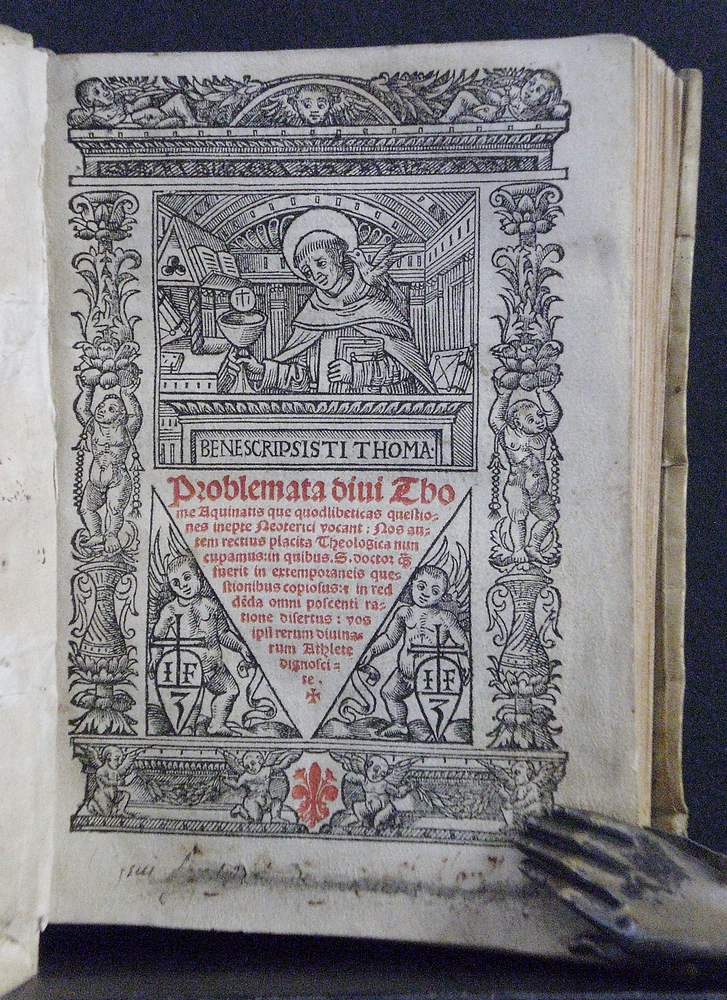
Campester, Lambert: PROBLEMATA DIVI THOME AQUINATIS QUE QUODLIBETICAS QUESTIONES INEPTE NEOTERICI VOCANT NOS AUTEM RECTIUS PLACITA NUNCUPAMUS (1520)
€1.800,00
Lambert Campester (XVI century AD)
PROBLEMATA DIVI THOME AQUINATIS QUE QUODLIBETICAS QUESTIONES INEPTE NEOTERICI VOCANT NOS AUTEM RECTIUS PLACITA NUNCUPAMUS.
Impresse Lugduni impensis Honorati Viri Jacobi Francisci de Giunta. In edibus Jacobi myt Calchographi Anno edite mundo salutis Millesimo quigentesimo vigesimo ad nonas septembris. (1520)
Description: [small 8vo] – leaves 156, (4) . POSTINCUNABLE.
A commentary on Thomas Aquinas doctrinal writings by the domenican Lambert Campester. The author was a indeed a curios unorthodox character and certainly an original man. He was a contemporary of Erasmus and is described in the foreword as a Theology Doctor candidate.
Among other things Campester had penned a revisited, unapproved and willingly manipulated edition of Erasmus Colloquia which he managed to get printed in Paris. From a letter of Erasmus dated 5th Oct. 1532, we gather some further particulars about him. Subsequently to his exploit at Paris, in printing the mentioned garbled edition of the Colloquies, he fled to Leyden; and there pretending to be a great friend and acquaintance of Erasmus, found a patron, from whom having soon stolen 300 crowns fled. In his flight was taken amongst some girls in dubious attitude, and would have been nailed to a cross, had not his sacred Dominican cowl saved him.” He, I say, many other offences and crimes having been proved against him, is at length in a certain town of Germany, called, I think, Zorst, in the Duchy of Juliers,—his cowl thrown aside, teaching the Gospel, that is, mere sedition. The Duke begged them to turn the fellow out. They answered that they could not do without their preacher. And this sort of plague spreads from day to day.” And then again continuing to talk about Campester manipulation of his own writing . “It was lately printed [..] with certain passages corrected, that is to say, corrupted, which appeared to attack monks, vows, pilgrimages, indulgences, and other things of that kind held in great esteem among the people”.” This rogue added a new Preface in my name, in which he represented three men sweating at the instruction of one boy: Capito, who taught him Hebrew, Beatus Greek, and me, Latin. He represents me as inferior to each of the others alike in learning and in piety; intimating that there is in the Colloquies a sprinkling of certain matters which savour of Luther’s dogmas. And here I know that some will chuckle, when they read that Capito is favoured by such a hater of Luther with the designation of an excellent and most accomplished man”
Definitely a singular character, otherwise unknown, worth of note mostly, if not exclusively, through the indignant reaction he seems to have generated in one of the most brilliant and prolific humanists of his times.
Text displayed on two columns in a very neat and elegant gothic typeface, many woodcut decorated initials in the text, beautifully carved woodcut titlepage in double colour portraying in the upper part Thomas Aquinas in his studium holding a book and a goblet with the holy Eucharist and a dove symbolizing the Holy Ghost on his shoulder.
Title printed in red ink inscribed within allegorical frame and a red fleur-de-lis (adopted as printer’s device by Giunta for his editions) in the lower part. A deleted signature in the lower end of the titlepage, not disturbing, and another on the lower part of the leave Aii (recto). Very light marginal water stains in the upper right corner of the last few leaves, for the rest a very well preserved copy.
Contemporary binding in limp pigskin, which has been remounted, traces of antique handwritten title on the upper part of the spine, almost completely faded away. An attractive and well preserved copy.
Cfr.: BVB Bibliotheks Verbund Bayern, Bestand Universitätsbibliothek Eichstätt – Zentralbibliothek und Teilbibliotheken in Eichstätt (Sigel: 824) ref BV016464459; D.BOLLIGER, Infiniti Contemplatio: Grundzüge der Scotus- und Scotismusrezeption im Werk Huldrich Zwinglis, Brill (2003), p.78.


