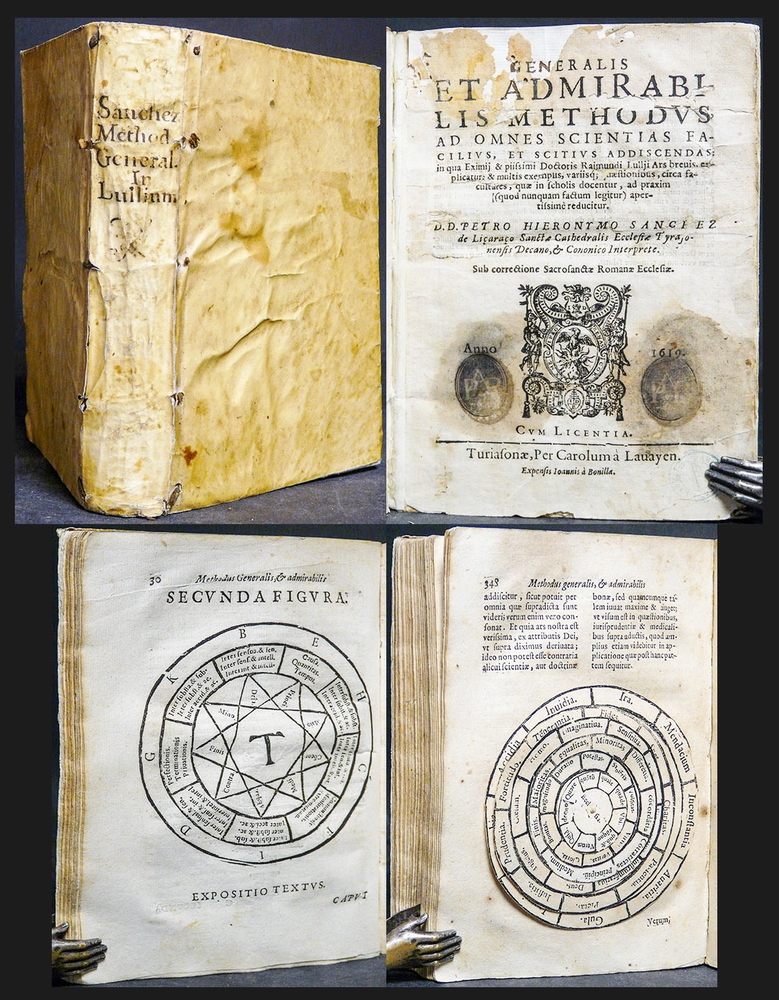
Sanchez de Lizarazo, Petrus Jeronimo (d. 1614) – Raymundus Lullus (1235-1315): Generalis et admirabilis methodus, ad omnes scientias facilius et scitius addiscendas : in qua eximij & piissimi doctoris Raimundii Lullij Ars breuis explicatur & multis exemplicatur … reducitur / … Petro Hieronymo Sanchez de Liçaraço Sanctae Cathe (1619)
€800,00
Petrus Jeronimo Sanchez de Lizarazo (d. 1614) – Raymundus Lullus (1235-1315)
GENERALIS ET ADMIRABILIS METHODUS, AD OMNES SCENTIAS FACILIUS, ET SCITIUS ADDISCENDAS: IN QUA EXIMIJ & PIISSIMI DOCTORIS RAIMUNDI LULLIJ ARS BREUIS, EXPLICATUR [..] D.D. PETRO HIERONYMO SANCHEZ DE LICARACO SANCTAE CATHEDRALIS ECCLESIAE TYRASONENSIS DECANO, & CANONICO INTERPRETE.
Turiasonae : per Carolum a Lauayen : expensis Ioannis a Bonilla, 1619
Description: [small 4to]- pp. [52], 426, [2] + illustrations and 2 woodcut volvelles; LULLISM. PHILOSOPHY. LOGIC.
The Autor Jeronimus Sanchez born in Biel (Zaragoza) (d. Madrid – 1614) is one of the many commentators of Lull and follower of the Lullistic philosophical movement he was a theologian and doctor in civil and canon law. The book is a commentary on the Artis Brevis, in which the logical theory developed by Lull is explained.
In essence Lull’s work is a sort of logical- mathematical system based on combinatory tables. Even though the Lullian system in itself did not achieve any scientific result it exerted in its times a considerable influence on many scholars and produced a lasting impression on the works of many others thinkers and philosophers after him. Lull invented an ‘art of finding truth’ through mathematical relations and combinations which inspired Leibniz’s dream of a universal algebra four centuries later. The most distinctive trait of his production is its logical and combinatory nature, and the use of complex semimechanical techniques that required figures with separately revolving concentric wheels (volvelles) or interconnected schemes.
These features justify its classification among the forerunners of both modern symbolic logic. The first four figures PRIMA, SECONDA, TERTIA and QUARTA FIGURA represents the combinatory tools invented by Lull to represents the logical connections between, subjects, predicates, premises and conclusions in logical sentences. Lull set himself to construct a method which, by mechanically presenting all predicates which could attach to any subject, was able to answer, in theory, any questions on any topic. He envisioned this system upon return from one of his voyages in the middle east, inspired by the zairja that was a mechanical device used by medieval Arab astrologers to calculate ideas by mechanical means. It used the 28 letters of the Arabic alphabet to signify 28 categories of philosophic thought. By combining number values associated with the letters and categories, new paths of insight and associations of ideas and thought were created.
The book includes six woodcut tables of which 2 volvelles, some decorated initials in the text woodcut tail and head pieces, woodcut printer’s device on title page depicting the Fenix and on the sides a knight and a woman inscribed in decorated frame with the motto Ex me ipso renascor. Damages on titlepage which has been restored and partially reintegrated with part of the title on the upper side of the title page handwritten, 2 partially cancelled ink stamps with a dark halo extending also to the first following pages, interiors present usual foxing and browning, last leaf ( errata corrige) with a repaired tear.
Our copy is complete notwithstanding the mentioned damages, the second leaf is mistakenly marked ¶3 (as it is the following leaf) for a typographical error. Contemporary binding in full limp wellum, with handwritten title on spine.
Cfr.: SARTON Introduction to the History of Science, II, (1931), pp. 900-914; JOHNSTON The Reception of the Lullian Art, 1450-1530, Sixteenth Century Journal, Vol. 12, No. 1 (Spring, 1981), pp. 31- 48; 16 Censimento delle Edizioni del XVI Secolo, ICCU Istituto Centrale per il Catalogo Unico , ref. T\ICCU\BVEE\071121


