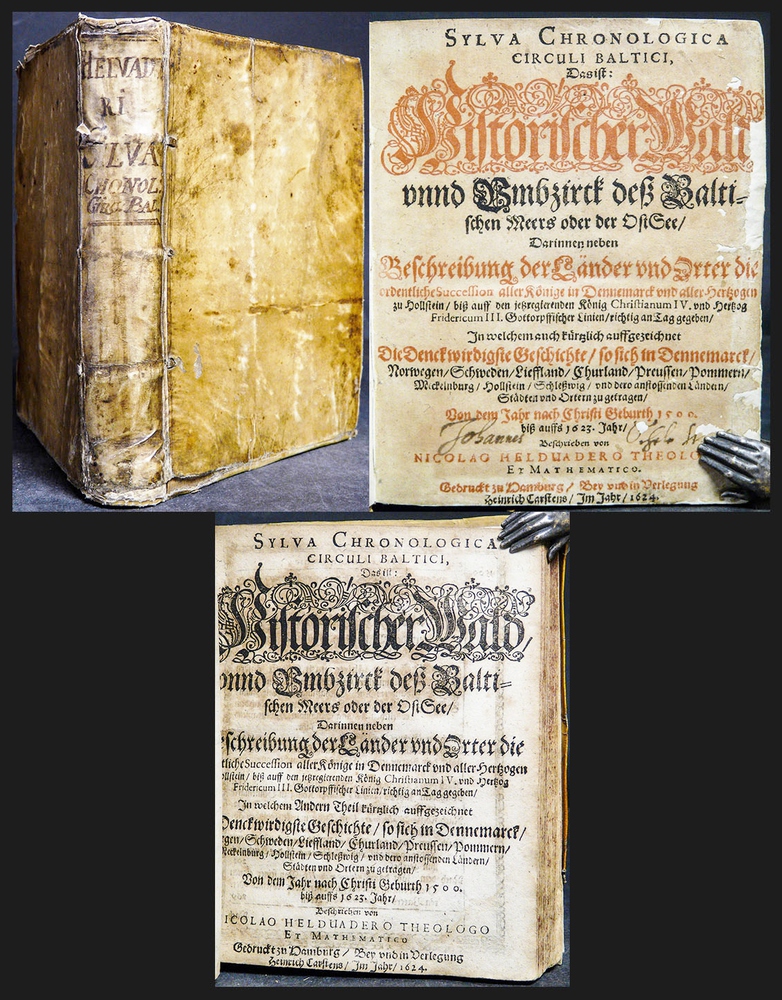
Heldvader, Nicolaus (1564-1634): Sylva Chronologica circuli Baltici, das ist Historischer Wald und Umbzirck deß Baltischen Meers oder der OstSee (1624)
€1.300,00
Nicolaus Heldvader (1564 -1634)
SYLVA CHRONOLOGICA CIRCULI BALTICI
Hamburg, bey und in Verlegung Heinrich Carstens, 1624
Description : [small 4to] – 2 parts in one volume. (20), 135, (b) + 327, (b). HISTORY. BALTIC AND NORDIC STATES.
Heldvad took his name from his home village Hellevad (German: Hellewatt) in the northern part of the Duchy of Schleswig. After attending grammar schools at Flensburg, Haderslev (Hadersleben), Luneburg and Lubeck, he spent a year in Riga and the surrounding area (1586/87), mainly working as a private tutor. He continued his education at Rostock University until 1590 when he was appointed to succeed his father as pastor of Hellevad. Due to Heldvader’s opposition against the Calvinizing policies of the ducal government, he lost his post in 1611. From 1616 onward he earned his living in Copenhagen as royal calendar and almanac maker and wrote books on diverse subjects. Heldvader published in the literary languages current in his home village and in Copenhagen, that is, Danish, High German and Low German. Of his many publications, the present work written in High German is devoted to the history of the countries around the Baltic Sea, the Circulus Balticus. His work is quoted among the sources of Just Mathias Thiele’s collection of Danish legends from the first half of the nineteenth century. One of the so-called legends is taken from a Danish book of 1618 containing stories related to the ecclesiastical calendar, in which Heldvader tells many well-known stories from the European tradition. It is a substantially rare book, of which the present copy (1624) is a first edition.
Contemporary full stiff vellum mounted on wooden boards, handwritten titles on spine, endpapers substituted with new ones. The title page of the first section, restored with reinforcing paper on the back, is in double color red and black ink in elaborately decorated german gothic typeface of the XVII century; woodcut decorated initials in the text entirely included in typographical frame, interiors in overall good antiquarian conditions, some browning and foxing due to age and kind of paper typical of german editions of the time, same pages more markedly brown, a few antiquely written notes, including a nice heraldic tree and other antique notes in old calligraphy on the recto of the last 2 leaves.
Cfr.: HARTZ, Die Rungholtsage bei den nordfriesischen Chronisten, in: Jahrbuch des Nordfriesischen Vereins für Heimatkunde und Heimatliebe 20 (1933), p. 80-86 ; J BAAZIUS, Inventarium ecclesiæ sveogothorum, Linköping 1642, p. 765-770


